The Evolution of Mediumship: From the Fox Sisters to the Modern Stage Performer
The evolution of mediumship: From the Fox sisters to the modern stage performer by Psychic Medium Kristian von Sponneck
Mediumship has never been static. It has never been one fixed thing, frozen in time, practiced the same way from generation to generation. It has always reflected the culture around it, the fears and fascinations of the era, the collective grief of entire communities, and the longing of ordinary people to believe that death is not the end. If anything, mediumship has evolved precisely because human beings have evolved, and as our understanding of psychology, trauma, intuition and consciousness has grown, so too has the way we interpret our experiences with Spirit. To understand where modern mediumship stands today, it is necessary to look back—far back—to the birth of modern Spiritualism, and to remember how it all began with two young girls in a quiet American farmhouse.
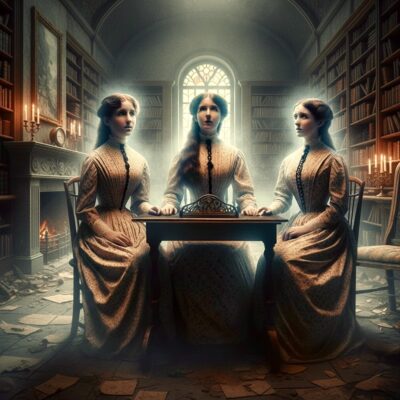
The story of the Fox Sisters has been told so many times that it has taken on a semi-mythical quality, yet it remains the foundational moment of contemporary mediumship. In 1848, Maggie and Kate Fox reported that a Spirit, nicknamed “Mr Splitfoot,” communicated with them through raps and knocks in their Hydesville home. Whether those rappings were genuine, misinterpreted, exaggerated, performed, or a chaotic blend of several factors has been debated endlessly. What matters most is that the public believed something extraordinary was happening—and from that belief, a movement erupted. The Fox Sisters became overnight sensations, performing in packed halls, astonishing both the grieving and the curious. Spiritualism spread across America and Europe with explosive force, fuelled by a population ravaged by disease, war, and high infant mortality. People were desperate for reassurance, and mediumship offered them a lifeline.
As the decades passed, mediumship transformed from a parlour novelty into a full-blown cultural force. Séance rooms filled Victorian households. Public demonstrations became theatrical affairs featuring trumpets, levitations, apportations, and slate writing. Some of these phenomena were genuine attempts to explore the unknown. Many others were illusions, encouraged by a world hungry for spectacle and entertainment. This era remains controversial because it reveals the two sides of mediumship: the longing for truth, and the temptation to dramatise. Where there is demand for magic, there will always be people willing to create it—by any means necessary. But it also produced remarkable mediums whose reputations, despite scepticism, continue to intrigue researchers even today. The Victorian period laid the groundwork not only for communication with Spirit, but for the performance of mediumship as a public event.

As we travel forward into the early twentieth century, we see mediumship shaped by both belief and scientific scrutiny. Investigators, psychical researchers, magicians, sceptics, and academics all entered the arena. While some exposed fraud, others confirmed astonishing phenomena. Whatever the outcome, the attention legitimised mediumship as a subject worthy of serious study. This was the era when trance mediumship flourished, automatic writing surged in popularity, and Spiritualist churches began to formalise their philosophies. Mediumship slowly shifted away from theatrical physical phenomena and moved closer to a style focused on communication, empathy, accuracy, and healing. People were no longer satisfied with table levitations. They wanted names. Memories. Details. They wanted evidence.
By the mid-twentieth century, particularly in the UK, mediumship had become intertwined with community, comfort, and post-war grief. Spiritualist churches offered something different from religion and different from entertainment: they offered contact. Not performance, not escapism, but connection. Mediums stood on platforms, relaying messages with clarity and compassion, their work rooted far more in communication than spectacle. This era laid the foundations for the modern British mediumship style—informal, conversational, emotionally grounded, and focused on evidence-first messaging.
From the 1980s onwards, mediumship moved once again. Television arrived. Cameras entered séance rooms, studios, theatres and homes, and the medium suddenly became a public figure. The pressure to perform increased. Audiences wanted immediacy. They wanted speed. They wanted perfection. The theatrical roots of the Victorian era re-emerged, not through trumpets and darkened rooms, but through the demand for flawless, rapid-fire evidence delivered with the confidence of a performer and the certainty of a presenter. It was no longer enough simply to connect; mediums were expected to be consistent, accurate, entertaining, emotionally soothing, and unshaken by pressure. The public platform had changed, and mediumship had to change with it.
This evolution continues today, where the modern medium stands at a crossroads of psychology, performance, intuition, ethics, grief work, social media, and audience expectation. The theatre medium, the church medium, the private-reading medium, the psychic entertainer—all share the same roots but navigate completely different worlds. And in this era, mediumship must be far more accountable than ever before. Audiences are more educated. Sceptics are louder. Social media exposes everything. At the same time, we now understand trauma, loss and human psychology in ways the Victorians never could. A medium today must not only be intuitive; they must be emotionally literate, ethically sound, and deeply aware of the responsibility they hold when delivering messages to the grieving.
As someone who works both as a medium and psychic entertainer, I see this evolution not as a series of disconnected phases, but as a continuous arc. Mediumship is not the same as it was in 1848, nor should it be. We owe it to the people we serve to evolve. We owe it to Spirit to refine our work. We owe it to ourselves to remain grounded, honest, and unattached to the theatrics that once overshadowed the true purpose of connection. We stand on the shoulders of history—with all its triumphs, controversies, illusions, discoveries, and truths.
The Fox Sisters lit the match. The Victorians fanned the flame. The mid-century mediums carried the torch. And today, each of us who steps onto a stage, into a church, or in front of a single grieving individual, holds that flame in our own hands. Mediumship isn’t perfect. It has never been perfect. But it has endured because humanity needs it. And no matter how much the world changes, the longing to know that love continues will always remain.
That is why mediumship survives.
That is why it evolves.
And that is why it still matters today.
You may like my last post, click the following to read When Are Spirit Around Us?