Why Social Media Has Changed Mediumship for Better and Worse
Why social media has changed mediumship for better and worse by Psychic Medium Kristian von Sponneck
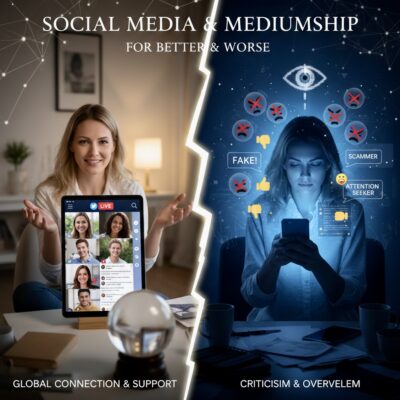
Introduction: There Are Two Sides To It
Social media has changed mediumship more in the last decade than almost anything else in modern history. What was once experienced primarily in private sittings, spiritualist churches, theatres, and live demonstrations is now broadcast daily through phones, short-form videos, livestreams, and algorithms. Mediumship has become accessible, visible, and constant.
That visibility has brought genuine benefits. It has also created serious problems. From my perspective as a working psychic medium, social media has strengthened mediumship in some areas while actively damaging it in others. The same platforms that allow people to witness real communication have also become breeding grounds for fakery, performance, and highly questionable behaviour.
As with most things, there are two sides to it.
How Social Media Helped Mediumship Reach More People
There is no denying that social media has opened mediumship to audiences who may never have stepped into a church, theatre, or private reading room. People can now see demonstrations, hear explanations, and observe how different mediums work without committing financially or emotionally.
For genuine mediums, this has allowed transparency. People can watch how information is delivered, how uncertainty is handled, and how communication unfolds in real time. It has also allowed discussions around ethics, expectations, and boundaries to reach far wider audiences.
Social media has also helped demystify mediumship. When used responsibly, it can show that mediumship is not about drama, theatrics, or mystical performance, but about perception, interpretation, and human connection.

Education Versus Entertainment
One of the biggest positives of social media is education. Short videos, longer discussions, and written posts can explain how mediumship actually works, what it is not, and why nothing is ever guaranteed. This has helped counter unrealistic expectations created by television and stage sensationalism.
However, social media is driven by engagement, not accuracy. Algorithms reward speed, certainty, emotional impact, and confidence. Nuance does not perform well. Pauses do not perform well. Honesty about uncertainty does not perform well.
As a result, mediumship online often shifts away from education and towards entertainment. And that is where problems begin.
TikTok and the Rise of Performative Mediumship
TikTok in particular has changed the landscape dramatically. The platform rewards instant hooks, bold claims, and emotional punchlines. This environment is fundamentally incompatible with genuine mediumship, which is slow, interpretive, and uncertain by nature.
What we now see repeatedly are generic statements framed as psychic insight. Comments sections are used as validation. Followers fill in the gaps. Recognition is created socially rather than evidentially.
Many of the so-called mediums on TikTok are not demonstrating mediumship at all. They are performing intuition, personality, and confidence. The worst examples are those who repeatedly target vulnerability, grief, and fear to drive engagement.
The Problem With the Usual Fake Suspects
Anyone who has followed my Facebook posts will already know my stance on certain recurring figures, including the usual fake suspects such as “psychic medium dean” and others operating in a similar way. These accounts follow predictable patterns. They speak in absolutes. They never hesitate. They never miss. They never appear uncertain.
If it looks too good to be true, it probably is.
These individuals often recycle the same statements, the same delivery, and the same emotional hooks. Comments are used as confirmation rather than evidence. Critical thinking is discouraged. Anyone questioning the content is blocked or ridiculed.
This is not mediumship. It is content creation dressed up as spirituality.
Why Social Media Rewards the Wrong Things
Genuine mediumship often looks messy (see prior blog post why genuine mediumship often looks messy). It includes pauses, clarification, uncertainty, and emotional recalibration. Social media rewards the opposite. It rewards confidence without doubt, answers without process, and certainty without accountability.
As a result, those who are honest about the limitations of mediumship often struggle for reach, while those willing to exaggerate or fabricate thrive. This creates a distorted public understanding of what mediumship actually looks like.
People begin to believe that real mediumship should be instant, flawless, and emotionally overwhelming. When they then experience genuine mediumship, it can feel underwhelming simply because it does not match what they have been conditioned to expect.
The Damage This Does to the Public
The biggest victims of fake online mediumship are not other mediums. They are the public. Vulnerable people are led to believe they are receiving messages from loved ones when in reality they are receiving generic statements designed to apply to anyone.
This can create emotional dependency, false hope, and distorted grief processing. It can also make people cynical and dismissive of genuine mediumship after realising they have been misled.
When mediumship becomes a popularity contest rather than a responsibility, trust is eroded across the board.
Why Genuine Mediums Often Avoid Social Media Performance
Many genuine working mediums either avoid social media entirely or use it cautiously. That is not because they have something to hide. It is because real mediumship does not translate well into short-form, edited content.
You cannot compress nuance into thirty seconds. You cannot demonstrate uncertainty without it being misinterpreted as weakness. And you cannot show the full ethical context of a reading through a viral clip.
As a result, those doing the most honest work are often the least visible online.
The Responsibility of the Viewer
Social media has placed a new responsibility on the audience. Viewers must learn to question what they are seeing. Does the medium allow uncertainty? Do they acknowledge misses? Are they asking questions or making statements? Are they open to challenge?
If every video looks perfect, every message lands instantly, and every comment says “this is exactly me,” something is wrong.
Mediumship does not need perfection. It needs integrity.
Social Media Is a Tool, Not the Problem
Social media itself is not the enemy. It is a tool. Used responsibly, it can educate, inform, and demystify. Used irresponsibly, it can exploit, mislead, and distort.
The problem is not visibility. The problem is dishonesty.
Mediumship should never be about chasing likes, followers, or validation. It should be about remaining truthful to what is perceived, even when that truth is uncomfortable or unpolished.
Conclusion: Respect Is Needed
Social media has changed mediumship for both better and worse. It has increased access, visibility, and discussion. It has also amplified fakery, performance, and exploitation, particularly on platforms like TikTok.
Genuine mediumship does not need to look impressive to be real. In fact, when it looks too perfect, it is often anything but. Real mediumship includes uncertainty, pauses, and honesty. Those qualities rarely go viral, but they are the very things that protect integrity.
As mediumship continues to evolve in the digital age, the responsibility lies with both mediums and audiences to recognise the difference between communication and performance. Mediumship is not content. It is a process. And it deserves far more respect than social media trends currently allow.
You may like my last post, click the following to read Why genuine mediumship often looks messy