Mediumship Does Not Owe Anyone Proof
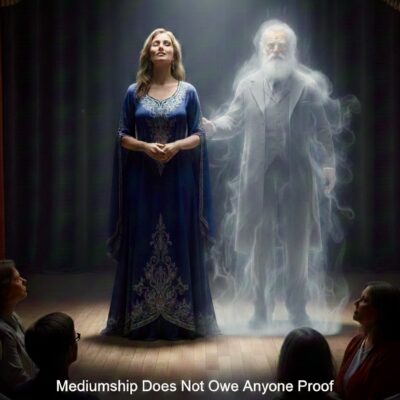
Mediumship does not owe anyone proof by Psychic Medium Kristian von Sponneck
Introduction: Mediumship is Not a Service Designed to Convince
One of the most damaging ideas surrounding mediumship is the belief that it owes anyone proof. That a medium must demonstrate on demand, satisfy scepticism, or provide evidence in a way that meets someone else’s criteria. This expectation has grown louder in recent years, fuelled by social media, debate culture, and an increasing demand for instant answers.
From my perspective as a working psychic medium, this mindset fundamentally misunderstands what mediumship is and how it operates. Mediumship is not a service designed to convince, convert, or perform under pressure. It is a process of communication that either occurs or does not, depending on conditions that are not controlled by the medium or the sitter.
Proof is not something spirit is obligated to provide, and mediumship does not exist to satisfy intellectual challenge.
Where the Demand for Proof Comes From
The demand for proof usually comes from discomfort. People want certainty in an uncertain world. When dealing with death, grief, or the unknown, the desire for something solid and undeniable is understandable. Proof feels safe. It feels grounding.
However, mediumship has increasingly been framed as something that must withstand interrogation. Sitters are encouraged to test, challenge, and judge every piece of information as though mediumship is on trial. This turns a communicative process into a confrontational one.
Mediumship was never meant to operate in that space.

Mediumship Is Not a Courtroom
Mediumship is not a debate, an argument, or a competition. There is no opposing side to defeat and no verdict to reach. When mediumship is treated like a courtroom, communication becomes strained and distorted.
Spirit communication is interpretive, symbolic, and responsive. It unfolds through perception rather than certainty. When a medium is forced into a position of defence, the process becomes about performance rather than communication.
Proof demanded under pressure is rarely honest proof. It is often shaped, forced, or simplified to meet expectation.
The Difference Between Evidence and Proof
This distinction matters. Evidence can arise naturally within mediumship. Proof is often demanded artificially.
Evidence in mediumship tends to be personal, contextual, and meaningful to the sitter. It may not mean anything to an outsider. Proof, on the other hand, is usually defined by external standards that have nothing to do with the experience itself.
When people demand proof, they are often asking for certainty that mediumship cannot ethically provide. Spirit communication does not arrive with timestamps, documentation, or guarantees.
That does not make it invalid. It makes it human.
Why Genuine Mediumship Does Not Perform on Demand
One of the clearest signs of authenticity in mediumship is the willingness to say no. No to pressure. No to expectation. No to demands for demonstration.
Spirit communication is not summoned like a service. It does not respond well to challenge or control. A medium who claims to produce proof every time, for everyone, under any condition, should invite serious scepticism.
Genuine mediumship includes uncertainty. It includes silence. It includes moments where nothing happens, and that honesty matters far more than forced results.
Social Media Has Warped Expectations
Social media has played a significant role in creating unrealistic demands for proof. Short clips, edited demonstrations, and confident delivery give the impression that mediumship should always be fast, flawless, and evidential.
What people do not see are the pauses, the misses, the adjustments, and the moments where communication does not occur. These are edited out because they do not perform well.
As a result, audiences begin to expect proof on demand. When real mediumship does not meet that expectation, it is dismissed rather than understood.
Proof-Seeking Often Blocks the Experience
Ironically, the demand for proof often blocks the very thing people want. When a sitter is focused on testing, evaluating, or catching errors, they are not present. They are observing rather than engaging.
Mediumship responds to presence, not scrutiny. That does not mean blind belief is required. It means that communication cannot unfold naturally when it is being interrogated at every step.
Scepticism does not block mediumship. Control often does.
Mediumship Is Not Here to Convince Anyone
This is an uncomfortable truth for many people. Mediumship does not exist to convert sceptics or validate belief systems. It exists whether someone believes in it or not.
A medium does not need to prove anything to justify their work. The value of mediumship lies in the experience itself, not in its ability to satisfy external challenge.
Some people will never accept mediumship, regardless of what occurs. That does not invalidate the experience for those who do.
The Ethical Problem With Owing Proof
When mediums believe they owe proof, ethical boundaries begin to erode. Pressure to deliver can lead to overstatement, interpretation, or embellishment. Lines blur. Integrity suffers.
Honest mediumship prioritises truth over satisfaction. It allows space for uncertainty. It accepts that not every sitting will provide what someone wants.
Mediumship that promises proof risks becoming performance rather than communication.
What Mediumship Actually Owes People
Mediumship does owe people something, but it is not proof. It owes honesty. It owes transparency about limitations. It owes respect for emotional vulnerability.
It owes the courage to say when communication is unclear or absent. It owes boundaries. It owes responsibility.
Anything beyond that becomes expectation, not entitlement.
Proof Is Personal, Not Universal
When meaningful evidence does arise in mediumship, it is often deeply personal. A phrase, a memory, an emotion, or a reference that resonates in a way that cannot be explained externally.
That kind of recognition does not need to convince anyone else. It does not need to be defended. Its value lies in its relevance to the person receiving it.
Trying to turn personal recognition into public proof strips it of meaning.
Conclusion: It Exists as an Experience
Mediumship does not owe anyone proof because it is not a performance, a test, or a belief system. It is a communicative process that operates through awareness, perception, and interpretation.
Demanding proof misunderstands the nature of spirit communication and places pressure where honesty should exist. Genuine mediumship includes uncertainty, silence, and limitation, and that is not a weakness. It is a sign of integrity.
Mediumship does not exist to convince the unconvinced or satisfy challenge. It exists as an experience. When it occurs, it stands on its own, without needing permission, approval, or proof.
You may like my last post, click the following to read If you could connect to anyone in spirit, who would it be?